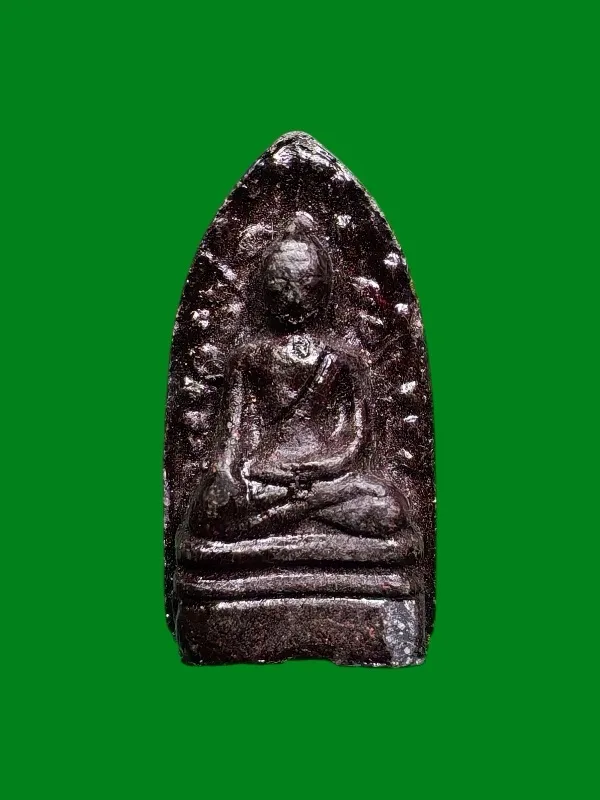
Within the prestigious pantheon of Thailand's Grand Five Votive Tablets (Benjapakee), Phra Rod of Wat Mahawan stands as the ancient, primordial ancestor. While popular folklore venerates the amulet as an impenetrable shield against mortal peril, academic archaeology, epigraphy, and material science reveal a profound cultural achievement: a 1,200-year-old masterpiece of 8th-century Dvaravati-Mon Buddhist civilization, rooted in the foundational chronicles of Queen Jamadevi and ancient high-temperature ceramic pyrotechnology.
1. The Hariphunchai Civilization (8th Century C.E.) and the Cardinal Mandala
Historical stratigraphy and epigraphical records confirm that the ancient kingdom of Hariphunchai (modern Lamphun, Northern Thailand) was established during the 12th–13th Buddhist Century (c. 660–750 C.E. / 8th Century C.E.). Unlike the later Tai-Lanna dynasties or Central Siamese kingdoms, Hariphunchai was an illustrious northern outpost of Dvaravati-Mon culture, defined by sophisticated Theravada monastic governance, advanced hydraulic urban planning, and distinctive Mon aesthetics characterized by serene, broad facial features, prominent downcast eyes, and heavy spiral hair curls.
Primary literary chronicles, notably the 15th-century Pali text Cāmadevīvaṃsa (authored by the venerable Bodhiramsi Mahathera of Chiang Mai) and the 16th-century Jinakālamālīpakaraṇa, record that the kingdom was laid out by the enlightened sage Vasudeva Risi of Mount Suthep in collaboration with Sukkathanta Risi of Lavo (Lopburi). Designing the city perimeter in the sacred geometry of a celestial conch-shell (Sangkhanakhon), the sages realized that lasting political sovereignty demanded an ethically upright Buddhist ruler. They petitioned King Chakravartiraj of Lavo to send his daughter, the devout Queen Jamadevi, to ascend the throne.
The Queen journeyed up the Ping River with 500 ordained monks, master architects, physicians, and artisans, establishing a sacred protective mandala of Four Cardinal Guardian Temples around the city walls:
- Western Cardinal Shield: Wat Mahawan — Sanctuary of Phra Rod (The Supreme Protector and Embodiment of Liberation).
- Northern Cardinal Shield: Wat Phra Khong Risi — Sanctuary of Phra Khong and Phra Bang (Guardian of civic resilience).
- Eastern Cardinal Shield: Wat Don Kaeo — Sanctuary of Phra Perm (Guardian of prosperity and agrarian abundance).
- Southern Cardinal Shield: Wat Pratu Lee — Sanctuary of Phra Liang (Guardian of evasion and military victory).
2. Petrological Science: Silathikhun, Crab-Burrow Silt, and Vitrification
Modern collectors marvel at how an unglazed terracotta tablet dating back over a millennium can resist physical erosion and ring with the metallic acoustic timbre of dense stone. Material petrography and ceramic science explain this phenomenon through a sophisticated two-tier matrix:
- The Raw Mineral Matrix: The base material was formulated using Silathikhun (a microcrystalline pyrophyllite and kaolinitic white rock pulverized into micron dust) combined with Din Khui Pu (subterranean colloidal silt brought to the surface by burrowing river crabs along the Kuang River). This naturally refined clay was virtually devoid of coarse quartz grits and extraordinarily rich in iron oxides ($Fe_2O_3$) and silica ($SiO_2$). Organic binders consisting of 108 medicinal botanical extracts and sacred pollens were kneaded into the slurry.
- High-Temperature Vitrification: The pressed tablets were baked in ancient updraft wood-kilns reaching temperatures between 950°C and 1,150°C. At these peak thermal conditions, the silica and natural mineral flux melted, undergoing liquid-phase sintering. The micro-pores collapsed, vitrifying the clay into an ultra-dense, semi-crystalline ceramic matrix with rock-hard durability.
Redox Chemistry and the Five Canonical Color Variants
The chromatic spectrum of Phra Rod does not stem from artificial pigmentation, but from kiln atmosphere and iron oxidation-reduction (Redox) dynamics:
- White / Pikul Yellow: Fired at lower peripheral kiln temperatures (approx. 800°C–900°C).
- Brick Red: Subjected to moderate thermal zones (900°C–1,000°C) under an Oxidizing Atmosphere, converting iron into vibrant ferric oxide ($Fe_2O_3$ - hematite).
- Krok Green: Reaching maximum sustained temperatures (1,050°C–1,100°C), where iron chemically fused with silica into dense iron silicates.
- Pot-Black & Multi-Tone (Nuea Phan): Formed in oxygen-starved Reducing Atmospheres, reducing iron into magnetite ($Fe_3O_4$). Pieces exposed to directional flame gradients display breathtaking dual-tone coloration, highly coveted by connoisseurs.
3. The Five Canonical Molds of Wat Mahawan
Centuries of connoisseurship categorize authentic Wat Mahawan Phra Rod into five primary typological molds:
- Phim Yai (Grand Mold): Regal proportions, expansive chest, deeply sculpted Bodhi leaf canopy, featuring the distinctive left-earlobe droplet and delicate "tear line".
- Phim Klang / Na Nu (Medium Mold / Mouse-Face): Elegant, elongated silhouette with a refined, triangular facial structure, traditionally designated by Thai experts as "Na Nu".
- Phim Lek (Minor Mold): Diminutive, exquisitely compressed proportions retaining fine iconographical precision.
- Phim Toh (Stout Mold): Muscular, compact torso with broad shoulders, conveying unshakeable geometric stability.
- Phim Tuen (Shallow Mold): Flatter relief depth, showcasing delicate, crisp classical carving lines.
4. Historical Chronology of Cache Discoveries in Rattanakosin
Contrary to modern misconceptions, the Wat Mahawan crypt did not yield its treasures in a single event, but across four distinct historical epochs:
- First Epoch (King Rama V Era, B.E. 2435–2440): The ancient brick chedi of Wat Mahawan collapsed from structural decay. Chao Luang Hemphinthuphaichit, ruler of Lamphun, sponsored a full royal restoration. Workers unearthed large quantities of ancient Phra Rod within the chedi core, which were formally distributed to royalty and senior court officials as the legendary "Kru Kao" (Old Cache).
- Second Epoch (King Rama VI Era, B.E. 2451): Abbot Phra Athikan Tha repaired the dilapidated boundary walls and ubosot foundation, revealing a second subterranean deposit.
- Third Epoch (Indochina War, B.E. 2483–2485): Monastic authorities carefully excavated additional pieces to bolster the morale of Thai soldiers deploying to border frontiers.
- Fourth Epoch (B.E. 2498, The "New Cache"): The venerable Phra Khru Yanamongkol uncovered an untouched cache buried beneath the root system of an ancient Pikul tree adjacent to the monks' quarters, known universally as "Kru Mai B.E. 2498".
5. Mid-20th Century Heritage: Wat Phra Singh B.E. 2496 & Luang Pho Pae B.E. 2514
Because authentic 8th-century Phra Rod tablets are museum-tier rarities valued in the millions of baht, the spiritual lineage of Hariphunchai clay was revitalized during pivotal moments of modern Thai history.
The absolute crowning achievement of this modern revival took place at Wat Phra Singh Woramahavihan in Chiang Mai in B.E. 2496 (1953). Monastic leaders gathered ancient fractured shards of genuine 1,200-year-old Wat Mahawan Phra Rod, pulverized them into sacred dust, and blended them with sacred soils from Bodh Gaya, India. The grand consecration was attended by Siam’s greatest masters, including Luang Pho Sodh of Wat Paknam, Luang Pho Ngern of Wat Don Yai Hom, Luang Pu Toh of Wat Pradu Chimphli, Luang Pu Nak of Wat Rakang, Luang Pu Phueak of Wat King Kaew, Luang Pho Rung of Wat Tha Krabue, and senior delegates from Wat Suthat, creating the most revered mid-century Phra Rod edition in existence.
Subsequently, in B.E. 2514, amid regional conflicts, Luang Pho Pae Khemmangkro of Wat Pikul Thong in Singburi formulated the historic Phra Rod Jong Aang Suk, incorporating ancient sacred clays to protect front-line soldiers deployed in defense of the realm.
6. Buddhist Iconology: The Diamond Victor and True "Vimutti"
Phra Rod portrays Gautama Buddha seated in the Vajrasana (Diamond Posture) beneath the sacred Bodhi tree canopy, with his right hand resting over the knee in the Bhūmisparśa Mudrā (Calling the Earth to Witness). This posture crystallizes the decisive moment of Enlightenment, when moral perfection and accumulated parami vanquished the legions of Mara.
While folk belief associates the Thai designation "Rod" exclusively with physical survival and bulletproof invulnerability, scholarly Theravada hermeneutics reveals a higher truth: the term signifies Vimutti (Spiritual Liberation)—the ultimate transcendence over the recurring cycle of suffering (Samsara), ignorance, and fear through unwavering mindfulness and moral purity.
🏛️ Dan Siam Curated Archival Specimens:
This historical analysis is corroborated by verified physical specimens from the Dan Siam Amulets Permanent Archive:
- • Phra Rod Wat Phra Singh Chiang Mai B.E. 2496, Phim Klang Na Nu [REF: #1723] — The supreme mid-century masterpiece formulated with crushed 1,200-year-old Wat Mahawan Phra Rod powder; blessed by LP Sodh (Wat Paknam), LP Ngern (Wat Don Yai Hom), LP Toh (Wat Pradu Chimphli), LP Nak (Wat Rakang), LP Phueak (Wat King Kaew), and Northern Kruba masters.
- • Phra Rod Jong Aang Suk by Luang Pho Pae, Wat Pikul Thong, B.E. 2514 [REF: #91] — Historic wartime protective amulet consecrated by Luang Pho Pae for soldiers deployed to combat zones.
- • Phra Rod Yai, Wat Phra That Doi Tung, Chiang Rai, B.E. 2516 [REF: #1452] — Consecrated with ancient Lamphun crypt clays; blessed in a grand Northern assembly by Luang Pu Waen and Luang Pho Kasem Khemako.
- • Phra Rod "Sedet Klab" Edition, Luang Pu Supha and Ajarn Chum Chaikiri, B.E. 2511 [REF: #45] — Consecrated in the historic Southern Return Ceremony, reviving the classical Phra Rod form with southern esoteric mastery.