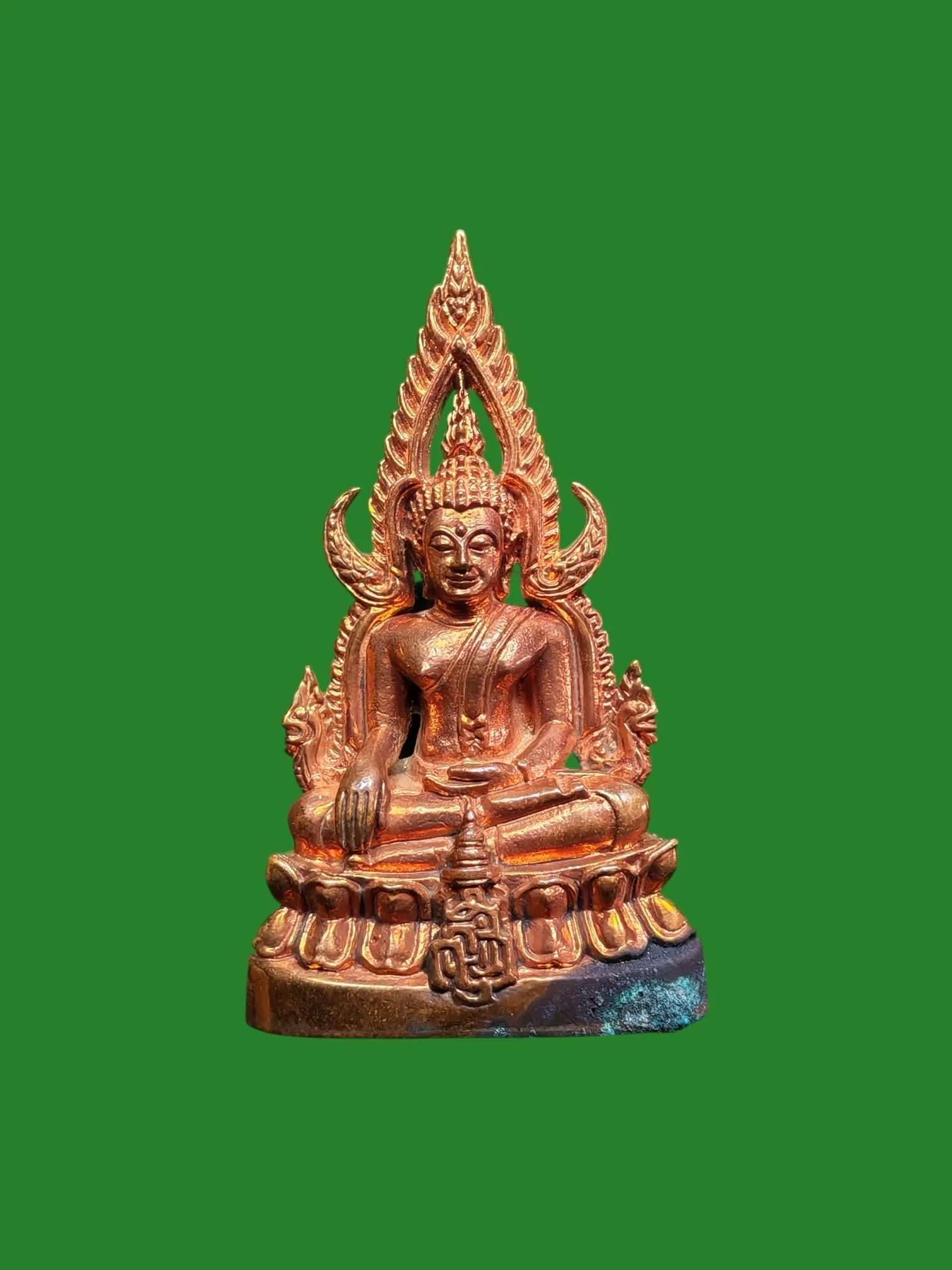
If one were to name the supreme bronze masterpiece universally revered as “The Most Sublime Buddhist Art in Siamese History”, the sacred image of “Phra Buddha Chinnarat” of Wat Phra Si Rattana Mahathat Woramahawihan in Phitsanulok stands uncontested as the pinnacle of sculptural grace and spiritual majesty.
When the Kingdom of Thailand was engulfed in the crucible of the Greater East Asia War (B.E. 2485 / 1942 C.E.), the historic casting of portable Phra Buddha Chinnarat votive statues at Wat Suthat Thepwararam united the collective soul of an entire nation. Yet in modern commercial folklore, an absurd and superstitious myth persists claiming that "wearing Phra Buddha Chinnarat brings fiery household discord or divorce." This authoritative treatise unites history, Mahayana-Theravada iconography, and sacred metallurgy to revisit the wartime crucible, decipher the true symbolism of the radiant arched shrine, and demonstrate the cooling reality of supreme spiritual victory.
1. Iconography of Siam: Genesis of Sukhothai Chinnarat & Prabhamandala
According to ancient northern chronicles, the primordial Phra Buddha Chinnarat was cast during the reign of King Maha Thammaracha I (Phaya Lithai) of the Sukhothai Dynasty around 1357 C.E. (B.E. 1900). Stylistically, it defines the “Late Classical Sukhothai Chinnarat School”:
- Anatomical Perfection: An expansive, oval countenance radiating serene equanimity, broad aristocratic forehead, soaring lotus-flame halo (Rasami), elongated earlobes, and the iconic feature of four fingers of equal length reflecting classical Great Man iconography (Mahāpurisa-lakkhaṇa).
- The Radiant Arched Shrine (Prabhāmaṇḍala / ซุ้มเรือนแก้ว): The elaborate filigree arch surrounding the Buddha does not represent destructive flames. It is an ornate Prabhāmaṇḍala carved with protective celestial Dragons and Naga Kings expelling scrolling floral motifs, symbolizing the sixfold aura (Chabbannarangsi) of cooling enlightenment radiating outward as the Buddha overcomes Mara.
- Māravijaya Posture: The right hand rests pronated over the knee pointing toward the Earth Goddess, summoning the earth as witness to thirty transcendental perfections. It symbolizes absolute, unconditional victory over inner demons, obstacles, and perils.
2. Flames of War to Faith: The Casting of Chinnarat Indochina B.E. 2485 at Wat Suthat
Between 1940 and 1942 (B.E. 2483–2485), Thailand was swept into the Franco-Thai Indochina conflict and World War II. Facing aerial bombardments and frontline combat, soldiers and civilians desperately sought spiritual protection. The Buddhist Association of Thailand, led by Pol. Gen. Phra Ram Intra, received royal and patriarchal permission to cast portable Chinnarat amulet statues.
The monumental consecration ceremony commenced within the Grand Ubosot of Wat Suthat Thepwararam on February 1, B.E. 2485. His Holiness Somdej Phra Sangkharat (Phae Tissadeva), Supreme Patriarch of Thailand, presided as monastic supreme leader, while Chao Khun Sri (Son Yattitharo), renowned master of ancient Phra Kring metallurgical rites, personally supervised the alloy formulation and foundry operations.
It remains the most legendary consecration rite in 20th-century Siamese history, convening 108 of the greatest enlightened ascetic masters from across the kingdom, including Luang Pho Jad (Wat Bang Krabao), Luang Pho Chong (Wat Na Tang Nok), Luang Pho Khong (Wat Bang Kaphom), Luang Pho Ee (Wat Sattahip), Luang Pho Derm (Wat Nong Pho), Luang Pho Pring (Wat Bang Pakok), and Luang Pu Phueak (Wat King Kaeo).
3. Metallurgy & Rites of Wat Suthat: Somdej Phra Sangkharat (Phae) and Chao Khun Sri (Son)
The supernatural prestige of the Indochina 2485 edition was engineered through the rigorous ancient metallurgy of Wat Suthat:
- Bronze & Ancient Bell Alloys: The foundational melt incorporated sacred master sprues from historic royal Phra Kring editions of Somdej Phra Sangkharat (Phae), blended with antique bronze gong bells, temple basins, and virgin yellow brass.
- 108 Yantra Inscriptions & 14 Na Invocations: Hundreds of consecrated gold, silver, and copper plates hand-inscribed with esoteric martial and protective yantras by masters across the nation were melted into the molten vat.
- Evolution into "Thong Dok Buab" (Squash Blossom Bronze): The precise elemental ratio of zinc, copper, tin, silver, and gold created a luminous golden-greenish alloy resembling the petal core of a squash blossom (ทองดอกบวบ). Over decades of atmospheric aging, authentic surfaces develop exquisite silvery sheen and organic fire-patina.
4. Anatomy of Authenticity: Sprues, Filing, and Stamped Dharma-Ok Lao Marks
In forensic archaeometry, the Indochina 2485 edition was cast utilizing the ancient banana-stalk tree runner system (หล่อช่อโบราณ), exhibiting distinct anatomical hallmarks:
- Base Sprue Severance Mark: After freeing the statues from their baked clay molds, each piece was sawn from its runner sprue, leaving a distinct circular cut mark approximately the diameter of a fingertip under the plinth.
- Master File Trimming: Ancient artisans used tempered steel hand files to plane the sprue and base smooth. Authentic file marks run in parallel, crisp, disciplined strokes—diametrically opposed to the messy circular abrasive scarring of modern rotary grinders.
- The Two Sacred Steel Stamps: Most authentic specimens received two deeply incised hand-stamped hallmarks:
- The Wheel of Dhamma (Dhammachakka): Signifying the turning wheel of truth that dispels mental afflictions and propels the bearer toward worldly and spiritual ascension.
- The Ok Lao Seal (อกเลา): Emulating the diamond-shaped lotus boss carved upon the central latch of the sanctuary doors at Wat Yai Phitsanulok—an emblem of unshakeable royal protection.
5. Consecrated Lineage in Dan Siam Archive: 3 Masterpiece Chinnarats
The Dan Siam Heritage Research Archive preserves three distinguished museum-grade examples of the Phra Buddha Chinnarat consecration lineage:
🏛️ Specimen I: [REF: #147] Phra Kring Phra Buddha Chinnarat YSS B.E. 2543 Thong Dok Buab, Blessed by Luang Pu Mun
Archive Reference: REF: #147 | Provenance: Consecrated with the royal patriarchal cipher YSS of Somdej Phra Nyanasamvara
A magnificent cast bronze Phra Kring in luminous Thong Dok Buab alloy, echoing the golden splendor of the ancient Indochina foundry rites. Bestowed with the royal monogram YSS by Somdej Phra Nyanasamvara, Supreme Patriarch of Thailand, and consecrated in a grand imperial ceremony at Wat Yai Phitsanulok with Luang Pu Mun Thitasilo of Wat Ban Jan presiding in deep samadhi. The internal bell bead resonates with pristine clarity. Flawless preservation.
👉 View Studio Macro Photography & Alloy Metallurgy [REF: #147]
🏛️ Specimen II: [REF: #1601] Phra Buddha Chinnarat Reverse Wheel of Dhamma B.E. 2512, Wat Rajnadda (Consecrated by LP Kuay, LP Toh, LP Pae)
Archive Reference: REF: #1601 | Provenance: Grand Vietnam War-era ceremony uniting three supreme masters of Siam
Pressed from dense holy powders in a luminous ivory-white hue, this tablet depicts the Chinnarat Buddha framed by the Wheel of Dhamma on the reverse. Consecrated at Wat Rajnaddaram in B.E. 2512 by a titan triumvirate: Luang Pho Kuay (Wat Kositaram), Luang Pu Toh (Wat Pradu Chimphli), and Luang Pho Pae (Wat Pikulthong). Provides omnidirectional protection, clears obstacles, and accelerates commercial fortune.
👉 View Studio Macro Photography & Tri-Master Consecration Archives [REF: #1601]
🏛️ Specimen III: [REF: #1675] Phra Buddha Chinnarat Cast Bronze Navaguna Alloy, Silver Base B.E. 2543, Wat Bowonniwet
Archive Reference: REF: #1675 | Provenance: Wat Bowonniwet royal court lineage, full nine-metal bronze with solid silver base plate
Cast in classical miniature proportions using the ancient Navaguna (nine-metal) formula of the Royal Monastic Court. The oxidized surface has matured into a lustrous obsidian black patina. The solid silver base plate is cleanly hallmarked with the official committee stamp. Emanates commanding leadership charisma, executive dignity, and steadfast protection.
👉 View Studio Macro Photography & Official Committee Hallmarks [REF: #1675]
6. Demolishing Myths: Does Chinnarat Cause Marital Strife or Heat?
One of the most irrational and superstitious falsehoods circulating in commercial circles is the claim that "wearing Phra Buddha Chinnarat introduces fire into a marriage, leading to domestic discord and divorce." In Buddhist theology and spiritual philosophy:
- The Buddha as the Extinguisher of Fires: Gautama Buddha is hailed as the supreme physician who quenches the three burning fires of greed (Lobha), anger (Dosa), and delusion (Moha). The Maravijaya posture signifies absolute mental pacification. Venerating the Buddha brings profound domestic harmony, loving-kindness, and mental coolness.
- Misinterpreting the Arch as Fire: The misconception arises from uneducated observers mistaking the intricate Prabhāmaṇḍala arch for destructive flames. In reality, it represents radiant spiritual light and water-dwelling Naga protectors—symbols of fertility, rainfall, and peace.
- The True Cause of Domestic Conflict: Marital discord is entirely the karmic consequence of human ego, dishonesty, and a lack of the Four Immeasurables (Loving-Kindness, Compassion, Sympathetic Joy, Equanimity). The image of Chinnarat serves as a constant reminder to practice patience, forgiveness, and mutual respect.
7. Epilogue: The Victorious Buddha, Sovereign Peace, and Spiritual Light
The title “Chinnarat” (ชินราช) translates literally as “The Victorious King”.
The victory embodied by Phra Buddha Chinnarat is not achieved through weapons, military subjugation, or worldly malice, but through absolute mastery over one’s own fear, doubt, and spiritual darkness.
When reverently wearing the image of Phra Buddha Chinnarat, let it illuminate the bearer’s path with moral courage and serene wisdom, shielding the bearer from all adversities and leading family, career, and spiritual life toward enduring peace and triumph.