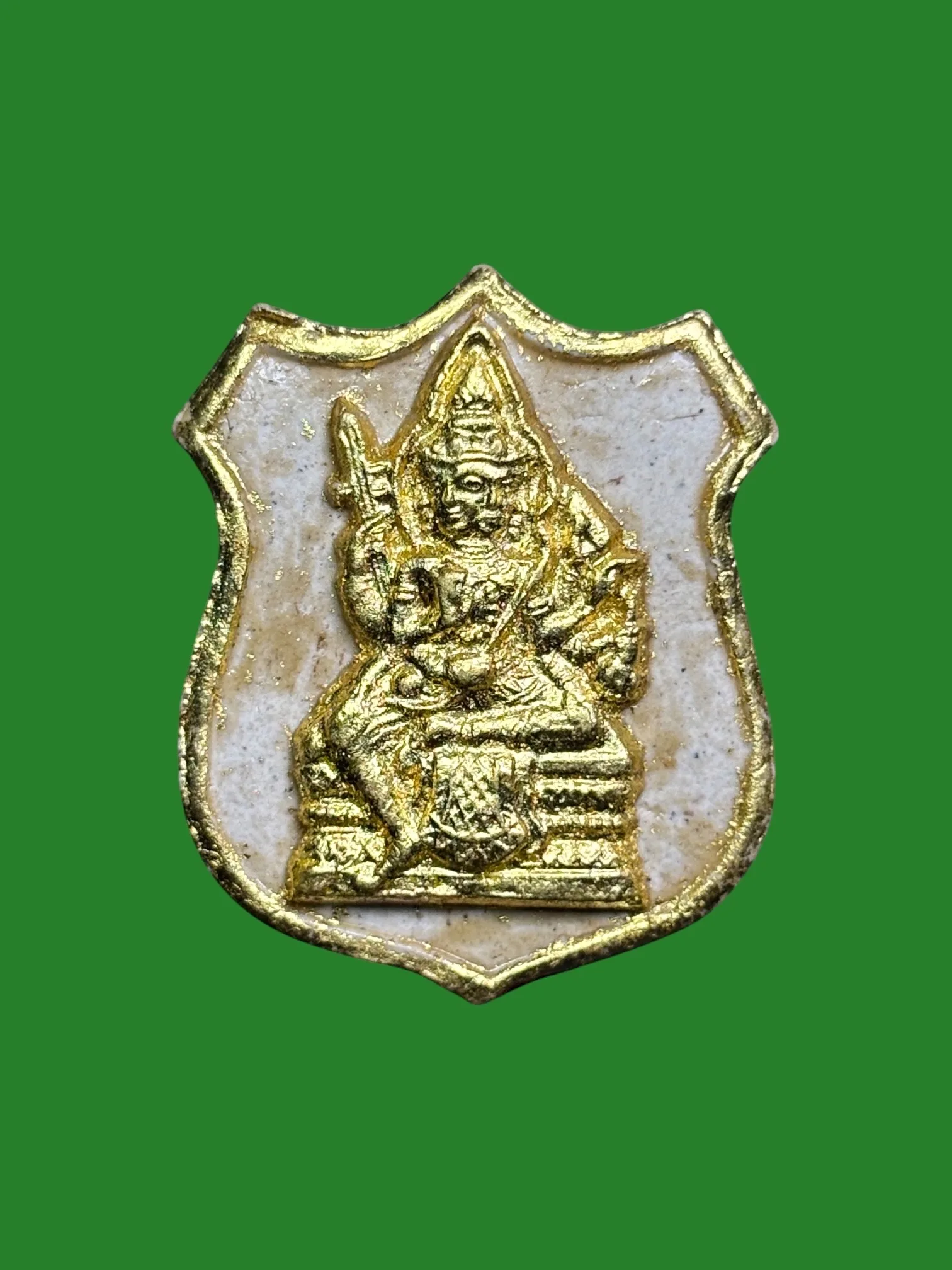
In the vast expanse of Siamese sacred art and Ayutthayan esoteric traditions, few votive tablets embody a theological depth as profound as Phra Nuea Phrom ("The Buddha Over Brahma") consecrated by Luang Pu Du Prommapanyo (1904–1990 C.E.) of Wat Sakae, Ayutthaya. Revered as an embodiment of the Bodhisattva ideal, Luang Pu Du synthesized classical Theravada scripture, mineralogical alchemy, and contemplative mysticism into a single rectangular tablet.
Yet in contemporary commercial markets, this profound emblem is frequently degraded into a mere "wealth-fetching trinket" or a transactional shortcut to material elevation. This scholarly monograph deconstructs the pop-culture myths, analyzing the canonical Brahmanimantanika Sutta, the mineral chemistry of Phra Dhamma Dhatu (sacred crystalline recrystallization), and the profound metaphysical philosophy of ego dissolution.
1. The Iconography of Subjugation: Deconstructing the "Buddha Over Brahma" Paradigm
The iconic form of Phra Nuea Phrom depicts the Historical Buddha Shakyamuni seated in the peaceful Dhyana or Maravijaya mudra directly above the crowned head of the four-faced Maha Brahma, framed by an aureole arch (Chum Ruean Kaew) or double-lotus dais.
Far from expressing sectarian hubris or physical oppression, this semiotic arrangement represents Māna-Nirodha—the absolute cessation of spiritual pride and conceit through transcendent wisdom. The Buddha's supreme enlightenment surpasses the highest heavens of cyclic existence. This visual theology directly materializes Stanza 8 of the classical Phra Phutta Chaiyamongkol Katha (The Eight Victories of the Buddha):
"Duggāhaditthi-bhujagena datthahatthaṃ, Brahmaṃ visuddhijutim-iddhi-bakābhidhānaṃ; Ñāṇāgadena vidhinā jitavā munindo, Tantejasā bhavatu te jayamangalāni."
"The Lord of Sages conquered the mighty Baka Brahma—whose mind was constricted by the venomous serpent of eternalist false views—by applying the supreme medicine of transcendent wisdom. By this spiritual victory, may ultimate blessings be yours."
2. Brahmanimantanika Sutta: The Cosmic Dialectic in Rupavacara Heavens
The textual foundation of this sacred tablet is recorded in the Pali Canon: Majjhima Nikaya, Sutta 49 (Brahmanimantanika Sutta). Baka Brahma, dwelling in the effulgent purity of the primary Jhana heavens for uncounted cosmic eons, succumbed to the fatal delusion of Sassataditthi (Eternalism). He proclaimed: "This state is permanent, stable, eternal, and complete. Here there is no birth, aging, death, or passing away; beyond this, there is no higher salvation."
Perceiving this cosmic delusion, the Buddha ascended instantly to the Brahma realm to dismantle Baka Brahma's conceit. When challenged to a contest of supernatural concealment:
- Baka Brahma's Concealment: Brahma attempted to vanish into earth, water, fire, and cosmic space. Yet the Buddha tracked his subtle psychic frequency effortlessly, declaring his exact coordinate because Brahma remained within the mundane field of conscious becoming.
- The Buddha’s Concealment: The Buddha entered the Fire Kasina absorption and walked meditatively directly upon the crown of Baka Brahma’s head. While his voice resounded majestically throughout the celestial assembly, neither Brahma nor his celestial retinue could perceive his physical form.
Why was Brahma blinded? Because his outward-seeking ego looked across all dimensions but failed to examine the crown of his own head—the pinnacle of his pride. By manifesting above Brahma's crowning locks, the Buddha proved that conditioned existence can never encompass unconditioned Nibbana, leading Baka Brahma to relinquish his conceit and take refuge in the Triple Gem.
3. Buddhist Cosmology vs. Hindu Deism: Transience of the Brahma Realm
In classical Hinduism, Brahma is the eternal Demiurge—the cosmic architect of destiny. In Theravada Buddhist Cosmology, however, Brahmas are not uncreated gods, but sentient beings who attained celestial rebirth through mastery of the 4 Form Jhanas (Rupavacara) and 4 Formless Jhanas (Arupavacara):
| Comparative Dimension | Theravada Buddhist Brahma | Hindu Creator Brahma |
|---|---|---|
| Ontological Status | Conditioned entity (Sankhara) subject to Impermanence (Anicca) and Non-Self (Anatta). | Uncreated Creator God (Trimurti) and source of cosmic order. |
| Lifespan | Finite (measured in cosmic Mahakappas); upon exhaustion of Jhana karma, rebirth occurs. | Immortal or coterminous with the manifestation of Brahman. |
| Spiritual Pathway | Cultivation of the 4 Brahmaviharas (Loving-kindness, Compassion, Sympathetic Joy, Equanimity) linked to Vipassana. | Yajnas, sacrificial oblations, and ritual devotion. |
4. The Alchemy of Maha Chakraphat Powder & Mineralogical Carbonation Kinetics
One of the most extraordinary phenomena associated with Luang Pu Du’s sacred powder amulets is the spontaneous emergence of "Phra Dhamma Dhatu"—microscopic crystalline druse and sparkling bead-like mineral structures that erupt from within the matrix of the tablet.
The Sacred Formulation
- Pure White Portland Cement: Provides a refined calcium silicate ($ ext{CaO} cdot ext{SiO}_2$) matrix.
- Five Esoteric Powders (Phong Wiset 5 Prakarn): Phong Itthije, Pathamang, Maharaj, Trinisinghe, and Buddhakhun, inscribed and erased tens of thousands of times on slate boards by Luang Pu Du.
- Alms-Bowl Rice and Lustral Water: Natural starches acting as organic polymers and pure catalytic hydration water.
Thermodynamic Carbonation Kinetics
From the perspective of inorganic chemistry and mineralogy, this phenomenon is a slow solid-state carbonation reaction. When calcium oxide hydrates, it forms portlandite $ ext{Ca(OH)}_2$ within the porous microstructure. Over decades within the warm, sacred confines of Wat Sakae, atmospheric carbon dioxide ($ ext{CO}_2$) gradually diffuses into the pore networks:
Ca(OH)₂ + CO₂ ⟶ CaCO₃ (Calcite / Aragonite Crystals) + H₂O
This reaction precipitates exquisite micro-crystals of Calcite or prismatic needles of Aragonite. When catalyzed by the focused meditative consciousness of Luang Pu Du, these crystals display a gem-like optical brilliance that is forensically distinct from talcum residue, surface mold, or artificial chemical adulterations.
5. The Maha Chakraphat Matrix: The Bodhisattva Symbiosis of Luang Pu Thuat & Luang Pu Du
Luang Pu Du was venerated as sharing an unbroken spiritual continuum with Somdej Luang Pu Thuat of Wat Chang Hai, the quintessential Bodhisattva of southern Thailand. Luang Pu Du's sacred artifacts are imbued with this expansive universal compassion.
His core spiritual inheritance is the Maha Chakraphat Katha (The Great Emperor's Incantation):
"Namo Buddhaya, Phra Buddha Trai Ratana Nana, Mani Noppharat, Sisahassa Sudharma, Buddho Dhammo Sangho, Yadha-Phut-Mo-Na..."
This sacred formula is not an instrument of material petition, but a method to align one’s consciousness with the transcendent virtues of the Five Buddhas of the Bhaddakappa. Its practice is aimed at "Karmic Realm Alignment" (Prap Phop Phum)—transferring merit to departed spirits, celestial beings, and karmic creditors across unseen dimensions.
6. Certified Archival Specimens in Dan Siam Heritage Collection
To establish rigorous historical and material provenance, Dan Siam Heritage Collection presents three authenticated masterworks from the Wat Sakae lineage:
🏛️ Specimen 1: [REF: #1514] Phra Nuea Prom B.E. 2528 Wat Khok Mayom Issue (Gold-Brushed Sacred Powder)
Registry: REF: #1514 | Authentication: Certified Authentic by Major Industry Standards
Consecrated in B.E. 2528 to support the historic restoration of Wat Khok Mayom, Ayutthaya. Luang Pu Du personally infused his pure Maha Chakraphat powders and performed solo meditative consecration. Embellished with traditional gold brushing over pure white sacred cement, this tablet exhibits razor-sharp mold fidelity with full facial definition of the Brahma deity.
👉 Inspect Ultra-High-Resolution Microscopic Macro Imagery [REF: #1514]
🏛️ Specimen 2: [REF: #1518] Brahma Shrine Talad Chao Prom Coin B.E. 2525 (Flame-Patinated Striated Copper)
Registry: REF: #1518 | Condition: 100% Uncleaned Original Iridescent Flame Skin
Cast in B.E. 2525 to commemorate the consecration of the Brahma Shrine at Chao Prom Market—the commercial epicenter of Ayutthaya. Luang Pu Du consecrated this coin with the pure intention of blessing honest merchants and everyday citizens. Its surface displays untouched rainbow-hued thermal oxidation (Phiu Fai).
👉 Inspect Numismatic Die Striations and Consecration Stamp [REF: #1518]
🏛️ Specimen 3: [REF: #156] Phra Pid Ta B.E. 2520 (Foundational Maha Chakraphat Powder Matrix)
Registry: REF: #156 | Historical Context: Early Era Consecration
A seminal B.E. 2520 creation showcasing the early formulation of Luang Pu Du’s white sacred powder. It embodies the profound Buddhist discipline of sensory restraint (Indriyasamvara), symbolizing the inward cessation of mental defilements necessary for genuine spiritual realization.
👉 Inspect Early-Era Powder Texture and Curatorial Analysis [REF: #156]
7. Demolishing Commercial Superstition: From Transactional Deism to Brahmavihara
Luang Pu Du consistently reminded his disciples:
"No power in this world exceeds Karma... The sacred image can assist fifty percent, but the remaining fifty percent you must build through right action. Spiritual practice is not for begging money; it is for purifying the mind."
Ultimately, Phra Nuea Phrom is not an instrument of mystical dominance over rivals, but an enduring monument of mindfulness. It commands the devotee to relinquish personal conceit and cultivate the Four Brahmaviharas: Metta (boundless loving-kindness), Karuna (universal compassion), Mudita (altruistic joy), and Upekkha (serene equanimity in the face of worldly vicissitudes).