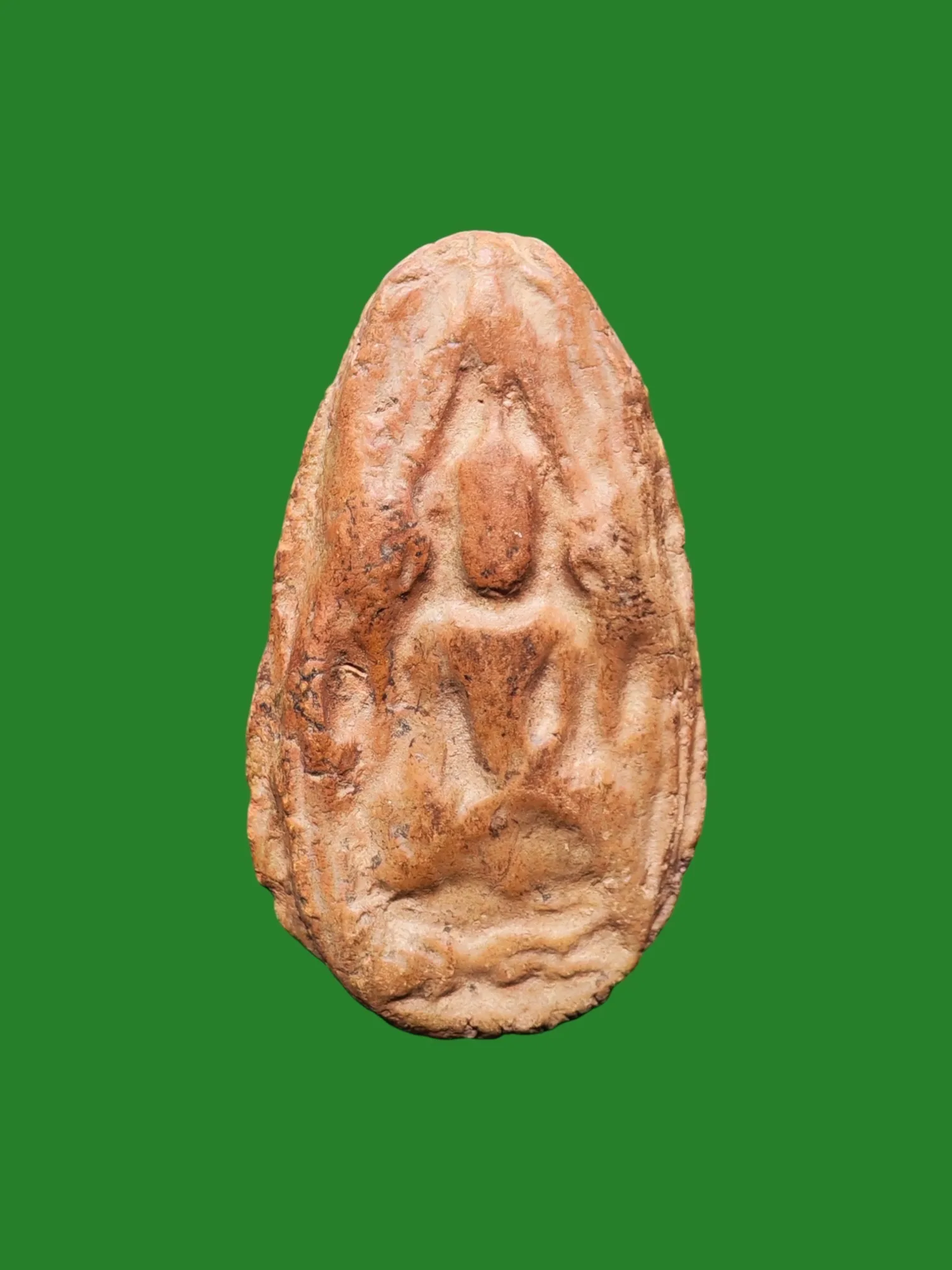
Within the supreme pantheon of Siam’s votive art known as the Benjapakee Grand Quintet, if Phra Somdej reigns as the King and Phra Nang Phaya as the Queen, the triangular, truncated-top terracotta tablet originating from the ancient soils of the Tha Chin River basin—renowned as “Phra Phong Suphan” of Wat Phra Si Rattana Mahathat, Suphan Buri—reigns supreme as The Ultimate Masterpiece of Irresistible Charisma (Metta Mahaniyom), Loving Compassion, and Invincible Protection.
Yet in contemporary commercial commerce, this sacred masterpiece is plagued by absurd misconceptions—most notably the fraudulent folklore claiming that authentic specimens "perpetually sweat aromatic oils from within." This authoritative forensic treatise combines archaeology, epigraphy, petrology, and the science of forensic dactyloscopy to travel back to 14th-century Suphannaphum, deconstructing the golden plate inscriptions of Maha Thera Piyadassi, the mechanics of ancient kilns, and the anatomical truth of ancient thumbprint ridges.
1. Archaeology of Wat Phra Si Rattana Mahathat Crypt & the B.E. 2456 Dig
Wat Phra Si Rattana Mahathat, situated on the western bank of the Suphan River (Tha Chin River) in Suphan Buri Province, was established during the 14th to 15th centuries C.E., during the reign of King Borommarachathirat II (Chao Sam Phraya) of early Ayutthaya. The architectural heart of the monastery is dominated by an immense Khmer-style brick prang stupa.
In B.E. 2456 (1913 C.E.), during the reign of King Rama VI, foreign tomb-raiders tunneled into the base of the central prang seeking buried treasures. Provincial authorities, led by Phraya Sunthonburi (Ou Pheungbun na Ayutthaya), Governor of Suphan Buri, intervened, secured the sanctuary, and formally opened the crypt under ministerial supervision.
The excavation revealed an astonishing cache of royal antiquities: solid gold and bronze Buddha sculptures, thousands of silver-alloy tablets, an immense chamber of baked clay votive tablets, and, most crucially, three inscribed Khom-Sukhothai golden manuscript plates, officially documented in the historical archives of the Ministry of Interior.
2. Deciphering the Golden Plates: Maha Thera Piyadassi & The 4 Rishis of U-Thong
The ancient golden inscription of Wat Phra Si Rattana Mahathat explicitly records the spiritual commission of the sacred clay tablets:
“...The Venerable Maha Thera Piyadassi Sariputta presided as the spiritual head of the Sangha, uniting in sacred accord with Rishi Pimpilalai as head of the hermits, alongside Rishi Ta Fai, Rishi Ta Wua, and masters of deep meditative absorptions. Together, they gathered 108 varieties of sacred medicinal herbs, floral pollens, and miraculous minerals, pressing this sacred clay image and enshrining it within the Great Prang to preserve the Holy Sasana for 5,000 years...”
This inscription documents an extraordinary syncretism between Sri Lankan Theravada Monasticism and the Indigenous Ascetic Hermit Traditions (Rishi Lore) of the U-Thong Suphannaphum Kingdom. Phra Phong Suphan is thus not merely a physical statue, but a concentrated matrix of enlightened monastic blessings and ascetic elemental empowerment.
3. Pure U-Thong Votive Aesthetics: Rectangular Visage to Maravijaya
Phra Phong Suphan represents the zenith of U-Thong Period II Classical Sculpture (Suphannaphum Art), exhibiting commanding anatomical geometry:
- The Rectangular "Grasshopper" Visage (หน้าตั๊กแตน): The face features a square, chiseled U-Thong jawline, broad prominent forehead, arched brow ridges, deep-set downcast almond eyes, an expansive broad nose, and a wide, firm mouth radiating stoic authority.
- Asymmetrical Ear Formation: In authentic molds, the right ear flares outward with a delicate upward flick at the tip, whereas the left ear descends vertically along the cheek to touch the shoulder—an indispensable hallmark of genuine archaic carving.
- Maravijaya on a Plain Plinth: The Buddha sits in tranquil virasana (half-lotus), the right hand resting pronated across the knee pointing toward the Earth Goddess, the left hand resting palm-upward on the lap. The base is completely austere, devoid of lotus petals, symbolizing rock-solid stability.
- Three Primary Mold Typologies: Archaeological classification identifies three distinct styles: Phim Na Gae (The Aged Face, chiseled and stern), Phim Na Klang (The Middle-Aged Face, balanced and serene), and Phim Na Num (The Youthful Face, slender and delicate).
4. Forensic Dactyloscopy: Loop Patterns, Whorls, and Manual Clay Thrust
The reverse side of virtually every genuine Phra Phong Suphan tablet bears the ancient thumbprint of its creator. In forensic anthropology and modern dactyloscopy, this manual impression provides absolute scientific verification:
- Biomechanical Thrust Mechanism: The ancient carvers utilized single-sided slate molds. After rolling clay into a ball, the artisan used their thumb (right or left) to exert intense pressure into the mold cavity, forcing the moist clay into the finest crevices of the front matrix before lifting their finger away.
- Authentic Dermatoglyphic Patterns: The impressions display genuine human skin friction ridges, categorizable into two primary dermatoglyphic archetypes: Loop Patterns (ลายมัดหวาย) and Whorl Patterns (ลายก้นหอย). Genuine ridge lines exhibit organic depth, micro-abraded grooves caused by silt grains, and subtle directional curvature.
- Natural Clay Spill and Shrinkage Fissures: The physical thrust of the thumb forced clay up around the lateral borders, creating raised ridges. During air-drying and subsequent kiln-firing, the clay shrank naturally, creating microscopic fissures and organic stress fractures that synthetic rubber molds cannot duplicate.
5. Archival Certified Evidence: 4 Suphan Buri Sacred Clay Relics in Dan Siam Archive
The Dan Siam Heritage Research Archive preserves four authenticated masterworks originating from the direct spiritual and material lineages of Suphan Buri:
🏛️ Specimen I: [REF: #1649] Phra Khun Phaen Khai Pha Early Edition, Luang Pho Thir Wat Pa Lelai B.E. 2495–2499
Archive Reference: REF: #1649 | Provenance: Consecrated with genuine crushed Phra Phong Suphan and Ban Krang ancient crypt materials
The iconic Khai Pha mold consecrated by Venerable Luang Pho Thir of Wat Pa Lelai, one of the greatest mid-century masters of Suphan Buri. He systematically incorporated fragmented authentic ancient Phra Phong Suphan and Wat Ban Krang tablets, pressing this historic early edition. Features the official temple seal pressed on the reverse, an ultra-dense desiccated clay matrix, and remarkable historical patina.
👉 View Studio Macro Photography & Material Specifications [REF: #1649]
🏛️ Specimen II: [REF: #1572] Phra Khun Phaen Soom Ruean Kaew Baked Clay, Luang Pho Thir Wat Pa Lelai B.E. 2499
Archive Reference: REF: #1572 | Provenance: Classical U-Thong palace arch aesthetics infused with ancient Suphan Buri powders
Crafted from fine baked terracotta blended with the Five Sacred Powders and ancient crypt clay. Consecrated by Luang Pho Thir in B.E. 2499, depicting the Buddha seated gracefully within an ornate arched shrine. Renowned for boundless charismatic appeal, compassionate patronage, and steadfast protection.
👉 View Studio Macro Photography & Mold Carving Analysis [REF: #1572]
🏛️ Specimen III: [REF: #1632] Phra Khun Phaen Phrai Khu Baked Clay, Luang Pho Khruean Wat Sangkhot B.E. 2499
Archive Reference: REF: #1632 | Provenance: Consecrated by the master renowned for breathing metaphysical life into terracotta
An exceptional twin-Buddha terracotta votive tablet created in B.E. 2499 by Luang Pho Khruean of Wat Sangkhositaram, an ascetic master endowed with formidable elemental mastery. Empowered through elemental harmonization to provide intense commercial attraction, mercantile prosperity, and warding against malevolent influences.
👉 View Studio Macro Photography & Clay Matrix Texture [REF: #1632]
🏛️ Specimen IV: [REF: #1738] Phra Ngop Nam Oi 10-Buddhas Circular Mandala, Luang Pu Nam Wat Noi Chomphu B.E. 2545
Archive Reference: REF: #1738 | Provenance: Consecrated by the direct lineage disciple of Luang Pu Suk and Luang Pho Niam
Pressed from fine floral and herbal holy powders by Luang Pu Nam of Wat Noi Chomphu. Depicts ten Buddhas radiating in a protective circular wheel, symbolizing complete protection across the ten directions, domestic harmony, and inexhaustible abundance.
👉 View Studio Macro Photography & Sacred Mandala Analysis [REF: #1738]
6. Deconstructing Commercial Myths: The "Sweating Clay" Fallacy vs Facts
One of the most persistent and damaging deceptions in commercial markets is the claim that genuine Phra Phong Suphan tablets "constantly exude fragrant natural sweat or oils from their core." Physical and forensic science thoroughly dismantles this myth:
- Desiccated Silicate Matrix: Ancient terracotta fired at 700°C–900°C and entombed for more than six centuries undergoes total moisture depletion. Its physical microstructure is fully stabilized as ceramic silicate stone, devoid of living cellular mechanisms capable of synthesizing oils.
- Fraudulent Oil-Boiling Techniques: The glossy, oily sheen found on counterfeit tablets is artificially produced by boiling fake clay in motor oil, coconut oil, or paraffin wax to simulate aged patina.
- Natural Surface Micro-Morphology: Authentic Phra Phong Suphan tablets exhibit dry, soft, stony surfaces with genuine sub-micron manganese oxide dendrites rooted in the pores. Any genuine oily sheen observed on ancient specimens derives entirely from decades of historic direct skin contact by ancient warriors who wore the tablets unencased.
7. Spiritual Synthesis: From Sacred Earth to the Armor of Equanimity
The timeless worth of Phra Phong Suphan does not derive from commercial speculation, but from the spiritual transmutation of base earth into an armor of Dhamma conceived six hundred years ago by the ancient masters.
Common alluvial clay from the riverbank, when kneaded with meditative mindfulness, infused with sacred mantras, and purified through the intense fires of the kiln, becomes as resilient and enduring as granite. In identical fashion, the human mind, when disciplined through Virtue (Sīla), Concentration (Samādhi), and Wisdom (Paññā), becomes unshakeable in the face of worldly turmoil—standing victorious over all obstacles as the supreme guardian of Siam.