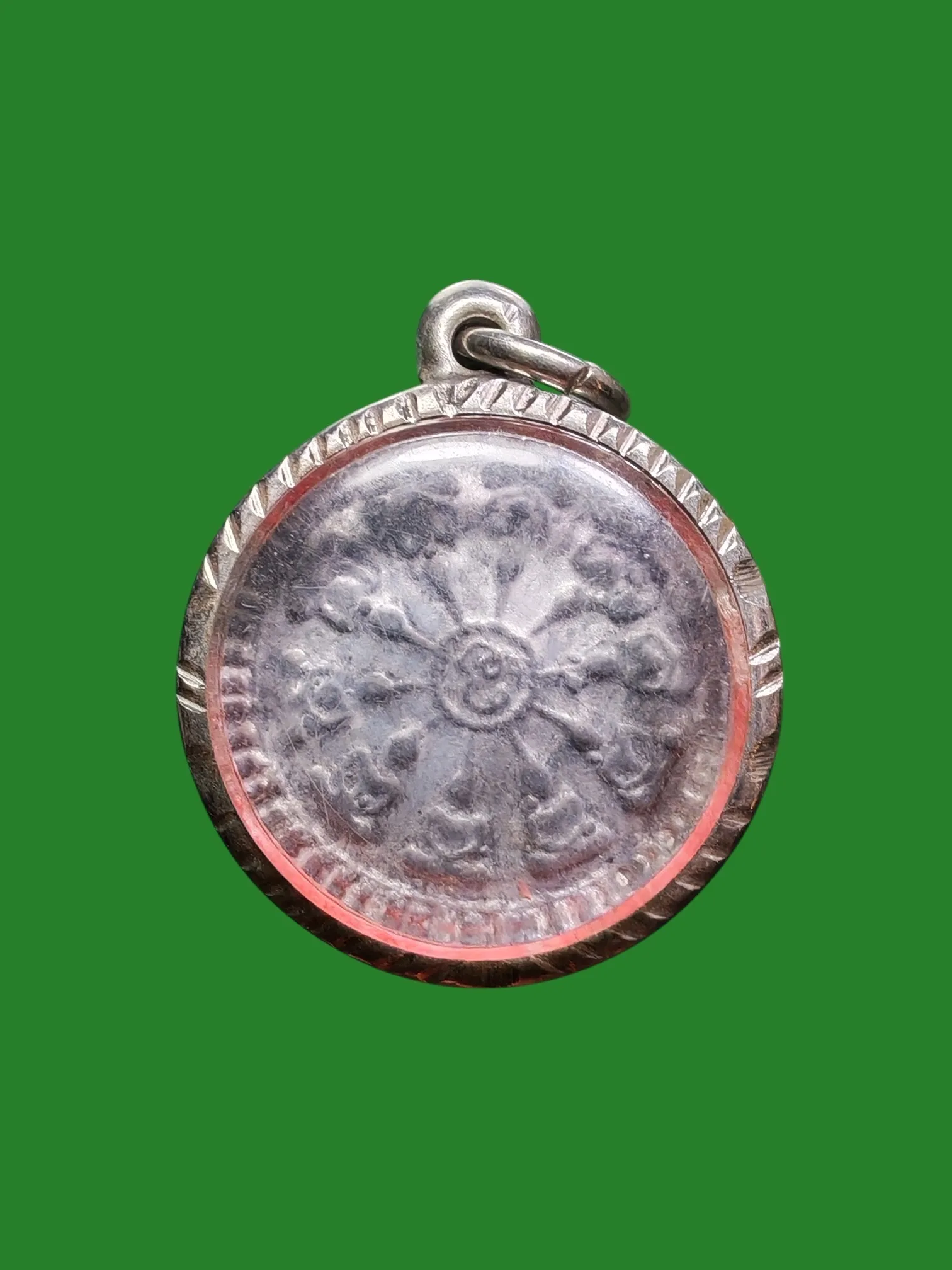
The serene, enigmatic silhouette of Phra Pidta (literally "the Buddha/monk closing the portals") or Phra Bhagavampati represents one of the most intellectually profound, aesthetically sovereign, yet egregiously vulgarized sacred icons in Thai Theravada Buddhism. For over a century, commercial folklore has degraded this sublime image into a rudimentary talisman for physical bullet-proofing (Kong Grapan) or miraculous debt-cancellation. In truth, Phra Pidta is the highest Buddhist sculptural embodiment of Indriya-Samvara (Sensory Faculty Restraint) and Nirodha-Samapatti (The Cessation of Perception and Consciousness), realized through the pioneering 19th-century organic chemistry of natural lacquered biopolymers (Phong Khluk Rak).
1. Theological & Art History: The Syncretism of Maha-Kaccayana and Gavampati
To understand Phra Pidta from an art-historical and canonical perspective, one must unravel a centuries-old cultural syncretism between two preeminent direct disciples of Gautama Buddha recorded in the Pali Canon:
1.1 Venerable Maha-Kaccayana: Renouncing Golden Beauty to Destroy Defilement
According to the Pali commentary (Atthakatha), Venerable Maha-Kaccayana was born into the high Brahmin lineage of Ujjeni, Kingdom of Avanti. The Buddha praised him as foremost among all disciples in explaining brief, cryptic Dhamma discourses into elaborate, lucid wisdom (Sankhittena bhasitassa). Born with an extraordinarily radiant complexion resembling molten gold and physical perfection mirroring the Buddha himself, his appearance inadvertently incited lust and worldly attachment among mortals—most famously recorded in the case of Soreyya, a wealthy merchant's son who conceived carnal desire upon beholding the elder and was transformed into a woman.
Mortified by becoming an obstacle to others' spiritual liberation, Maha-Kaccayana entered deep meditative absorption and willfully transformed his physical form into a rotund, stout, pot-bellied ascetic, casting aside all sensory vanity. In Buddhist iconography, this gave rise to the rotund, prosperous form with hands resting upon the belly, symbolizing cosmic abundance and radical detachment from physical form.
1.2 Venerable Gavampati (Bhagavampati): The Mon Sovereign of Meditative Power
Simultaneously, another stream of tradition centers on Venerable Gavampati, one of the four noble companions of Yasa who attained early Arahantship in the Deer Park at Isipatana. In canonical texts like the Gavampati Sutta, he demonstrated supreme supranormal mastery (Iddhipatihariya), famously arresting the surging floodwaters of the Sarabhu River to protect an encampment of monks.
In ancient Mon-Ramanya civilization (spanning Thaton, Pegu, and Dvaravati), Gavampati became venerated under the honorific title "Phra Bhagavampati"—a protective guardian deity of realms, controller of rains, and the supreme emblem of deep formless dhyana completely withdrawn from external reality.
⚖️ Comparative Canonical Analysis: Maha-Kaccayana vs Bhagavampati
| Criterion | Venerable Maha-Kaccayana | Venerable Gavampati (Bhagavampati) |
|---|---|---|
| Lineage & Origin | Brahmin priest caste of Ujjeni, Avanti | Wealthy merchant caste of Varanasi, companion of Yasa |
| Foremost Virtue (Etadagga) | Elaborating concise doctrinal teachings in depth | Mastery of elements, calming floodwaters, early Arahant |
| Devotional Epicenter | Classical Majjhimadesa & Pan-Indian Buddhism | Mon-Ramanya (Suvarnabhumi, Dvaravati, Lower Burma) |
| Iconographic Manifestation | Rotund belly, hands over abdomen (abundance/anti-vanity) | Hands covering sensory orifices, sensory closure (Samvara) |
As Mon communities interwove with Siamese culture during the Ayutthaya and early Rattanakosin periods, Siamese master sculptors merged Maha-Kaccayana's rotund body with Bhagavampati's portal-closing meditation posture, synthesizing the unique hybrid iconography known today simply as Phra Pidta.
2. Etymology & Nirodha-Samapatti: Deconstructing "Maha-Ut" into "Maha-Uttama"
During the tumultuous conflicts of the 19th and 20th centuries, folk culture warped the sacred term “Maha-Ut” into a literal martial enchantment: “plugging the muzzle of firearms, preventing ammunition discharge, or stopping hemorrhage.” This debased magical thinking is a complete corruption of canonical Dhamma.
2.1 The Pali Etymological Truth: "Maha + Uttama"
In historical Siamese military treaties and esoteric scriptures, this term was never spelled with the crude Thai word for obstruction (อุด - Ut). Rather, it was inscribed with the Pali-Sanskrit compound:
Mahā (Great) + Uttama (Supreme, Transcendent, Unsurpassed) = Mahā-Uttama (มหาอุตม์)
Maha-Uttama designates “The State of Supreme Spiritual Inviolability”—a mental sanctuary so pure, so detached from defilements (Kilesa) and sensory craving (Tanha), that no external contamination can penetrate its fortress. The closure is not an obstruction of physical brass bullets, but the absolute sealing of consciousness against psychological toxicity.
2.2 Two-Portal Restraint (Maha Lap) vs. Nine-Portal Restraint (Maha-Ut / Yant Yung)
Phra Pidta manifestations fall into two rigorous doctrinal classifications:
- Two-Portal Phra Pidta (Maha Lap - Supreme Fortune): The hands cover only the two physical eyes. This represents Cakkhundriya-Samvara (Restraint of the Eye Faculty). By blinding external distractions and superficial illusions, the practitioner opens the Dhamma-Cakkhu (Internal Eye of Wisdom) to perceive impermanence (Anicca) and non-self (Anatta). Mental tranquility naturally breeds ethical integrity, attracting sustainable wealth and nobility.
- Nine-Portal Phra Pidta (Maha-Ut / Yant Yung): Multiple pairs of hands seal all nine bodily orifices: two eyes, two ears, two nostrils, mouth, anus, and urethra. This directly references the canonical Vijaya Sutta (Sutta Nipata), wherein the Buddha characterizes the human body as a nine-gated fortress continuously leaking foul discharge and mental poisons. Sealing the nine portals symbolizes the complete severing of Phassa (Sensory Contact), halting the dependent origination of suffering (Paticcasamuppada).
2.3 Nirodha-Samapatti: The Metaphysical Armor Beyond Weapons
In the Visuddhimagga, Nirodha-Samapatti represents the ultimate meditative absorption, accessible exclusively to Non-Returners (Anagami) and Arahants who have mastered the eight meditative attainments (Jhana). In this state, bodily formation (respiration) ceases, verbal formation (subvocal thought) ceases, and mental formation (feeling and perception) vanishes completely.
While resting in Nirodha-Samapatti, an Arahant's physical vessel enters a temporary unconditioned state. Fire cannot burn it, torrents cannot drown it, and sharp blades cannot pierce it—not through sorcery, but as a natural ontological consequence of consciousness transcending matter. Siamese masters sculpted Phra Pidta as a tangible reminder that the mind completely pacified in Dhamma is the only impenetrable armor in existence.
3. Material Science: Natural Biopolymer Chemistry & Sacred Lacquered Powders
Far from being mere crude clay or chalk, antique Phra Pidta crafted from Phong Khluk Rak (Sacred Lacquered Powder) represents a pinnacle of 19th-century indigenous Southeast Asian biopolymer engineering and macromolecular cross-linking.
3.1 Biopolymer Chemistry of Gluta usitata Lacquer
The binder utilized by master monks is raw lacquer harvested from the Siamese lacquer tree (Gluta usitata, formerly Melanorrhoea usitata), rich in naturally occurring alkyl catechol derivatives, primarily thitsiol.
Unlike modern synthetic adhesives that dry through simple solvent evaporation, natural lacquer cures via an enzymatic oxidative polymerization catalyzed by laccase enzyme. This biochemical reaction requires atmospheric oxygen and relative humidity between 70% and 80%.
As laccase initiates catechol ring oxidation, long hydrocarbon side chains cross-link into a resilient dense three-dimensional macromolecular polymer matrix. This natural biopolymer is virtually impervious to water, weak acids, alkalis, and microbial decay. For over a century, this matrix has hermetically sealed delicate botanical herbs, mineral flakes, and sacred chalkboard chalk inside, developing a deep, lustrous, mirror-like antique patina when touched by human warmth.
🧪 Material Science Matrix: Lacquered Paste vs Lacquer-Dipped vs Oil-Bound
| Classification | Formulation & Chemical Bonding | Surface Micro-Morphology & Aging Characteristics |
|---|---|---|
| Phong Khluk Rak (Kneaded Lacquer Paste) | Sacred powders directly blended and kneaded with viscous raw lacquer into a homogeneous dough prior to pressing. Continuous 3D cross-linking throughout the entire core. | Extreme structural hardness, soft tactile warmth, deep chocolate-black interior, natural shrinkage wrinkles, developing a glossy obsidian sheen under magnification. |
| Phong Chum Rak (Lacquer-Dipped Powder) | Amulet pressed from sacred herbal powder with tung oil or banana paste; once dried, submerged into pure amber/black lacquer (Rak Nam Kliang) to form an outer sheath. | Translucent amber-reddish or pitch-black surface glaze. Over decades, tension differentials between the core powder and the lacquer skin induce natural microscopic tortoise-shell crazing. |
| Phong Namman (Tung Oil Bound) | Sacred chalk powder bound solely with boiled Chinese tung oil (Tang Yu), containing no raw tree lacquer. | Firm chalky texture, creamy off-white or light ivory hue, non-glossy matte patina, displaying subtle oil seepage halos over extensive periods. |
3.2 Decoding "Phong Solot Maha Mongkhon" of Wat Saphan Sung
The most legendary sacred powder in the annals of Siamese Pidta compounding is Phong Solot Maha Mongkhon, consecrated by Luang Pu Eiam Pathamanam of Wat Saphan Sung, Nonthaburi during the reigns of Rama IV and Rama V.
The master wrote and erased sacred chalk formulas upon slate boards across the sixteen heavens of the Form Realm (Solasa Brahma-loka):
- Solot Maha Mongkhon Yantra: Sixteen celestial chambers bounded by numerical permutation matrices and thirty cosmic perfections (Barami 30 Tas).
- Tri-Nisinghe Yantra: Esoteric numerological formulas neutralising twelve forms of misfortune, sorcery, and psychic decay.
- Jaturo Bang Kerd Sap Yantra: Summoning auspicious commercial prosperity from the four cardinal directions.
- Pathamang & Itthije Powders: Cultivating profound charismatic grace (Metta Mahaniyom) and ethical magnetism.
This potent dust was blended with 108 botanical herbs, dried lotus pollens from royal ceremonies, crab-burrow clay, underground stingless bee wax, and raw lacquer, creating an immortal numismatic talisman.
4. Archival Masterpieces in the Dan Siam Heritage Collection
The Dan Siam Heritage Archive curates two certified authentic, museum-grade specimens exemplifying both the Wat Saphan Sung transmission and the coastal Chonburi lacquered powder tradition:
1. Phra Pid Ta Pim Mae Krua by Luang Pho Thong Suk, Wat Saphan Sung, Nonthaburi (REF: #173)
Status: Certified Authentic National Standard
The Direct Saphan Sung Triumvirate Lineage: Blessed by Luang Pho Thong Suk Inthasaro, direct dharma successor to Luang Pu Klin and Luang Pu Eiam. Far from being a lesser commemorative mold, this "Kitchen Giveaway" edition was pressed using the exact same ancestral Phong Solot Maha Mongkhon powder reserve found in million-baht Chalood molds. Dipped in antique raw amber lacquer (Rak Nam Kliang), its surface exhibits half a century of organic micro-wrinkling and natural polymer contraction without synthetic manipulation.
2. Phra Pid Ta Phra Plad Phan Wat Bo So B.E. 2503 with Luang Pu Kaew Powder (REF: #166)
Status: Certified Chonburi Lacquered Heritage Piece
The Connoisseur's Bridge to Wat Khruea Wan: Created in B.E. 2503 by Phra Plad Phan (Phra Kru Phanom Silachan) of Wat Bo So, Phanat Nikhom, Chonburi—a Mon-lineage temple holding close historical ties to Wat Khruea Wan. Plad Phan retrieved authentic antique Itthije powder inscribed by Luang Pu Kaew of Wat Khruea Wan preserved inside ancient palm-leaf chests, kneading it directly with dark tree lacquer. It offers discerning scholars an accessible vessel containing genuine molecular remnants of the supreme Pidta master of Siam.
5. Cognitive Sovereignty: Sensory Restraint for Executives in the Information Age
In the hyper-connected 21st century, the foremost threat to executive leadership and human wisdom is not physical violence, but Information Deluge and Sensory Hijacking. Social media algorithms, 24-hour financial panic, corporate intrigue, and digital dopamine loops wage relentless war on cognitive equilibrium, inducing chronic reactivity, fractured attention, and flawed strategic decisions.
In this turbulent arena, Phra Pidta is the ultimate metaphysical emblem of Cognitive Sovereignty:
- Radical Selective Inattention: Sealing the portals is not passive escapism, but the intentional, disciplined refusal to process emotional pollution, panic, and deceptive noise that derail executive vision.
- The Sanctum of Deep Contemplation: Legendary strategists and sovereign minds routinely "close the gates"—severing notifications and external stimulation to enter the secular equivalent of Nirodha-Samapatti, cultivating the undisturbed stillness required for decisive breakthrough thinking.
- Imperturbable Equilibrium: Anchored in sensory restraint, the mind stands like a granite mountain, unmoved by worldly praise or blame, capable of navigating economic storms with majestic poise.
Venerating Phra Pidta is thus not a superstition of wishing for unearned riches, but a daily contemplative anchor: When we firmly close the external gates to sensory defilement, the inward gate to boundless wisdom, clarity, and sovereign success swings wide open.